Building Products Across Web, Mobile & Physical Access
Building products for web, mobile, and physical access
Digital products do not exist on a single surface.
They move across screens, devices, systems, operations, and, in some cases, physical spaces themselves.
Working across web, mobile, and access control has shown me that an experience cannot be designed in fragments.
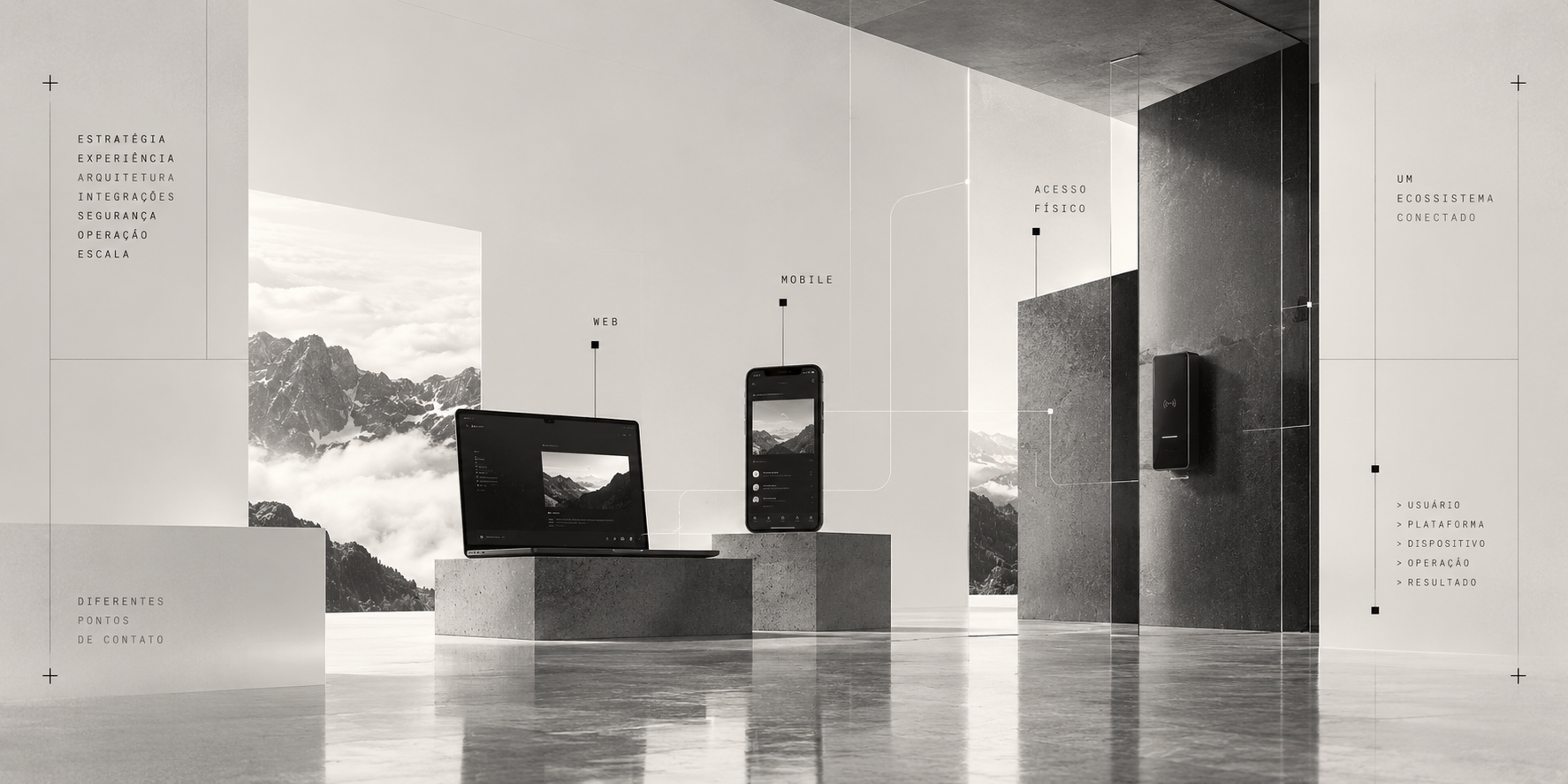
One product, different touchpoints
Web and mobile call for different contexts. Systems connected to the physical world add even more responsibility: availability, security, reliability, and real-time response become part of the experience.
That is why I like to think of each product as one system, even when it spans different interfaces.
The question stops being “how do we build this screen?” and becomes:
how do all these parts need to work together for the experience to feel simple?
Engineering as part of the strategy
Technical decisions directly shape a product's ability to evolve.
Architecture, integrations, data, permissions, and operations must support the present without limiting the future. That takes a balance of speed, quality, and room for change.
My focus is less on defending a particular technology and more on creating structures that let the product grow with clarity.
Experience happens beyond the interface
When software controls access, devices, or actions in the physical world, small details take on a different weight.
A failure is not just a broken screen. It can mean a door that will not open, information that never arrives, or a process that stops working.
That context has reinforced my view that product, operations, and engineering need to be considered together from the start.
Build systems, not surfaces
Working on web, mobile, and physically connected products has broadened the way I see development.
Interfaces matter, but they are only one part of the experience.
The real work is connecting technology, operations, and context so users do not have to notice all the complexity behind the product.
Good experiences cross platforms without losing clarity, consistency, or purpose.